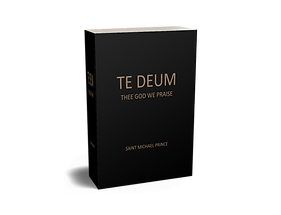
TE DEUM
THEE GOD WE PRAISE
Preface: La Madonna and Your Eyes
The Te Deum (from its incipit, Te Deum laudamus) is a Latin Christian hymn traditionally ascribed to a date before 500 AD, in which the term Te Deum can also refer to a short religious service (of blessing or thanks) that is based upon the hymn. In particular, it is the core of a short church service of thanksgiving held, often at short notice, to celebrate good news such as (1) a military victory, (2) the signing of a peace treaty, or (3) the birth of a royal child.
The hymn is in regular use in a variety of Christian churches, and is sung for many holidays including Easter, Christmas, and New Year’s Eve. However, the hymn is not sung on the feast of the Holy Innocents, which is a holiday that commemorates those martyred before the death of Christ. Coincidentally, the theories of the time of composition of the hymn estimates around 300 – 500 AD, which follows the period of mass persecutions of Early Christians in the first 300 years following Christ’s death.


Madonna
Drake
But I know who you are
You could be big as Madonna
Just get in the car and then let’s touch the road
Don’t make other plans
Say you get up early, you work for the man
Well, he’ll understand
Pull up, I’m pullin’ up on you in ten
Already on ten
Big as Madonna, I’ll say it again
The Madonna was portrayed standing, alone, often with a closed book on her stomach, an illusion to the Incarnate Word. The theological symbolism behind the representation is complex, as Madonnas have come in different forms throughout history; including iconic paintings and statues. The attribution of the importance of the depiction is the connection to its authenticity, which is typically perceived through the time in which the icons were created.
Debates have shrouded around the speculation of The Madonna, as well as The Holy Face of Jesus Christ. For The Madonna, controversy has sparked behind speculations of the variety of appearances of each individual representation, icon, or statue. Likewise, various depictions have formed around The Holy Face of Jesus Christ, with some specific images believed to be miraculously formed representations that were ‘not made by hands’. One scholar commented on the various acheiropoieta as, “Either they are images believed to have been made by hands other than those of ordinary mortals or else they are claimed to be mechanical… impressions of the original.” Nevertheless, these arguments based on appearance have had tremendous influence on society and individuals, forming a pattern. Even within modern popular culture, such as the star-studded couple, Madonna and Tupac Shakur, where the simplicity of the appearance of the couple became the breaking point for the relationship, as outsiders perceived in.
The paintings in the Vatican are said to represent the culmination of High Renaissance style in painting, because of the ambitious scale of these works, coupled with the complexity of their composition, closely observed human figures, and pointed iconographic and decorative references to classical antiquity. Pope Leo X strictly guided the commissions of a High Renaissance artist and was known to be one of the artist’s biggest patrons at the time. The artist delivered his most humanistic representation of The Madonna, as the incarnation of a realistic mother and child, portrayed subtly and naturalistically, including the drapery, her anatomy, and the movement of her body, as if it was a result of an immediate action. The Madonna is dressed in the Italian clothing of the time and the painting showcases the artist’s use of the tondo form, or the form of the circular or the rotondo.
The Madonna’s image also shows less attention to careful selections, which takes the focus off refinement, and shifts it to more of a rapid representation of an observation or attitude. By radically changing the scale of the figures in this painting, this particular Madonna revolutionized singular portrait painting by enlarging the figure’s scale and how they compositionally occupy the entire plane. La Madonna della Sedia is one of the single most important of the High Italian Renaissance artist – Raphael, housed at the Palazzo Pitti Collection in Florence, Italy.

Mariah
Saint Michael Prince
When I do drop in your city
I do not bring nothing with me, woah
I do not carry my wings, no
I got that pretty bit with me, woah
We gotta get on the road
Speedin' like a Tesla Roadster
Yeah you know I do the most
I believe in Holy Ghost
The nations are dying
Get to Mt. Zion
Where is Mariah
Sedia na Nina
Where is Mariah
What have you done to her
Where is Mariah
Sedia na Nina
Where is Mariah
What have you done to her
Where is Mariah


The Christ child and Mary are both in profile view in order to balance the composition, which resolved the issue of overcrowding. Mary is sitting in a position that is not easily replicated in reality, which allows the Christ child to sit comfortably, while balancing the figures in regards to the painting’s round shape. By radically changing the scale of the figures in this painting, allowing them to occupy most of the available space, the Christ child seems to be the basis for both the proportions and relationships within the painting.